Every podcast listener has watched the same move.
A host asks a real question. The guest, who has not prepared for it, asks the host one back. The host answers, because a host's job is to keep the conversation moving. Twenty seconds later the two of them are somewhere else entirely and the original question has quietly ceased to exist. Nobody had to refuse it.
That move works for one reason. Refusing to answer costs nothing.
Which is strange, because podcasting has solved almost everything else. It killed the gatekeepers, it proved that millions of people will happily sit through three hours of argument, and it built an economy on top of both. It is the most successful media format of the last twenty years and it deserves that.
It is also missing the one thing that would make it complete, and the fix has existed for centuries.
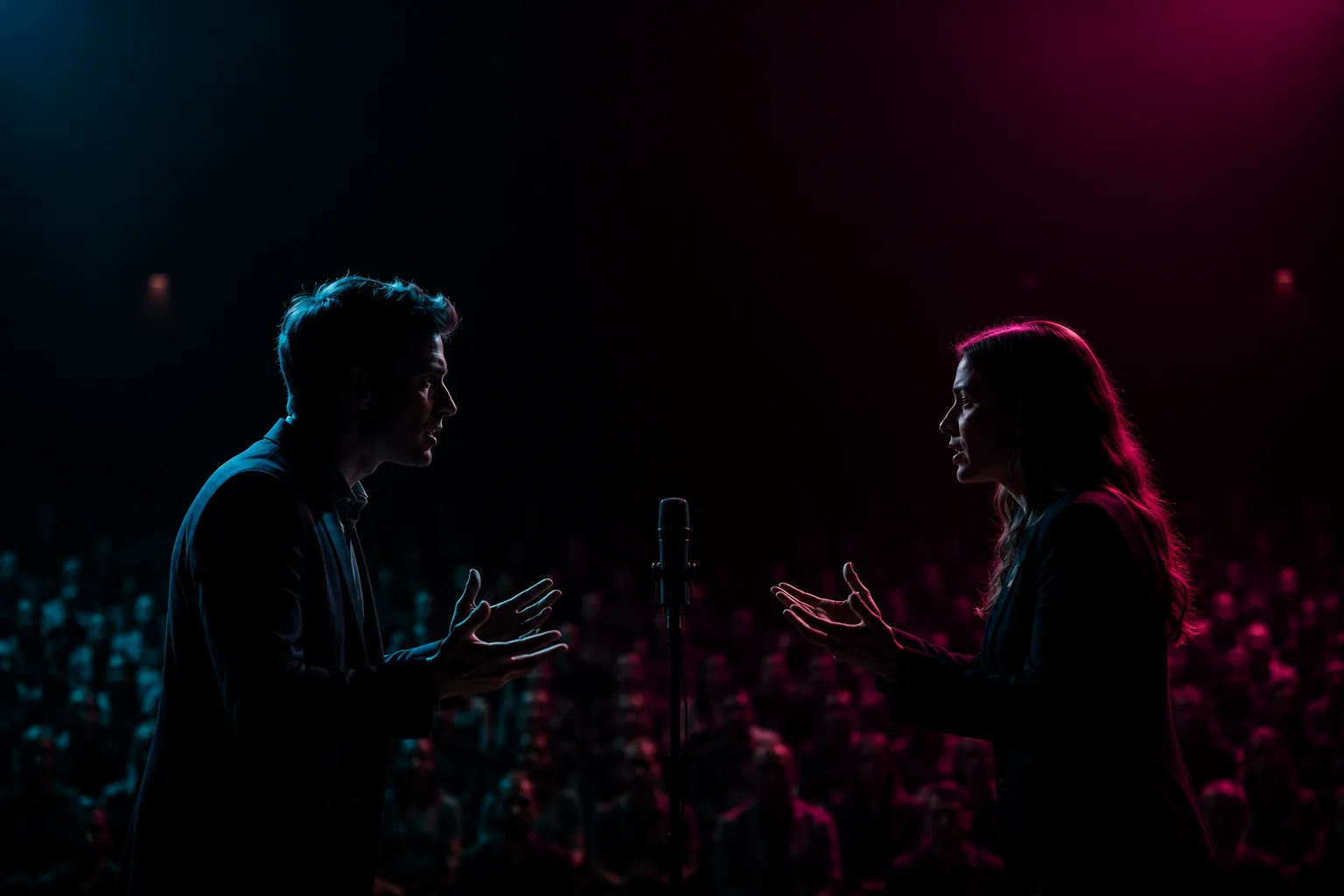
Formal debate figured this out a long time ago. A motion, two sides, time limits, and a vote at the end. The audience does not just watch, it decides, and the decision is the entire point.
What that format never had is reach. It happens in a room, in front of a few hundred people, and everyone else sees a clip afterwards with the result already settled.
Podcasting is the exact inverse. Infinite distribution, no resolution. Anyone can broadcast to millions, and nothing that happens in those three hours is ever adjudicated by anyone.
One format has the mechanism and no audience. The other has the audience and no mechanism. They have coexisted for twenty years and almost nobody has tried to put them together.
That is podcasting's next act, and it is the whole argument of this piece.
Why nobody can make a guest answer
It would be easy and wrong to blame hosts for the dodge.
Plenty of them push hard. Mehdi Hasan built a reputation on forensic questioning and rarely lets a claim past without a source. Piers Morgan will go at a guest until something breaks. Joe Rogan pushes in a different register, curious rather than combative, and that openness is a large part of why almost anyone will sit down with him.
Three different strategies, all legitimate, all operating inside the same constraint.
The interview has an asymmetry built into it. One person is the host. The other is the guest. The guest agreed to be there, can decline the next invitation, and can end the conversation by standing up. Every host is also a booker, and the booker needs next month's calendar to fill.
Then the constraint that matters more. Even the hardest interviewer alive cannot make a guest answer, because there is no penalty available. Press a fourth time and you become the aggressor, which is its own kind of loss.
The limit is not the interviewer's nerve. It is that the format has no way to make silence cost anything.
Most people who notice this problem conclude that podcasts need to be more combative. That is the wrong conclusion, and the shows built on it tend to be unwatchable.
A verdict is not the same as a fight. And it runs in two directions, which is the part that gets skipped.
Everyone focuses on penalising evasion. The more interesting half is rewarding the opposite. Think about the last time you watched someone come genuinely prepared. Not loud, not quick. Prepared. Someone who had the specific detail, the actual number, the exact quote, and used it to take apart a claim that had been stated as fact. Mehdi Hasan's Oxford Union debate on Islam is the example most people reach for, and it earned a reaction from that room you can still feel through a screen a decade later.
Now ask what happened to that reaction.
The room knew. The room responded. And then the room went home. Nobody watching could register that a particular point had landed, or reward the preparation behind it, or say that one was worth something. It existed for a few seconds and then it was gone.
We have built an entire internet economy on registering approval, and the one place it would genuinely mean something, we left blank.
The serious objection is not that people dislike debate. It is that debate makes things worse.
The case goes like this. Debate rewards the quick and the rhetorically gifted rather than the correct. It hardens positions, because defending a side in public makes you less likely to abandon it. It produces heat instead of light. And every televised political debate is evidence.
That objection is largely right about debate as it is usually built. It is wrong about why.
Those debates reward performance because of who the debater is performing for. When the prize is a viral clip, the winning move is the cutting line and accuracy is optional. When the prize is a room that votes at the end, the strategy inverts. You cannot dunk your way past people who are about to score you, and undecided people are not persuaded by a good burn. They are persuaded by whoever took the other side seriously and still had the better answer.
Change who holds the verdict and you change what wins. That is not a hope, it is the design.
Not shouting, and not a return to a debating chamber only a few hundred people can sit in.
Two people who both opted into the same rules, so there is no host and no guest and no asymmetry to manage. An audience that decides rather than observes. And a way to say, in the moment, that a specific point landed and was worth something.
That last part is not decoration. It is the difference between an audience that watched and an audience that was there.
Everything else is already solved. The reach exists. The appetite for long-form argument is proven beyond any doubt. The only missing piece is the oldest one, and it was never complicated.
Somebody just has to keep score.