Being right is not the same as being believed.
You can have the better evidence, the cleaner logic, the facts entirely on your side, and still lose the room to someone with none of it. Not because the audience is foolish, but because persuasion runs on three tracks at once, and most people only ever run on one.
Aristotle named the three tracks more than two thousand years ago, and nobody has improved on them since: ethos, pathos, and logos. Credibility, emotion, and logic. Every argument that has ever moved anyone was some mix of the three. Learn to pull all three levers on purpose and you stop leaving persuasion to luck.
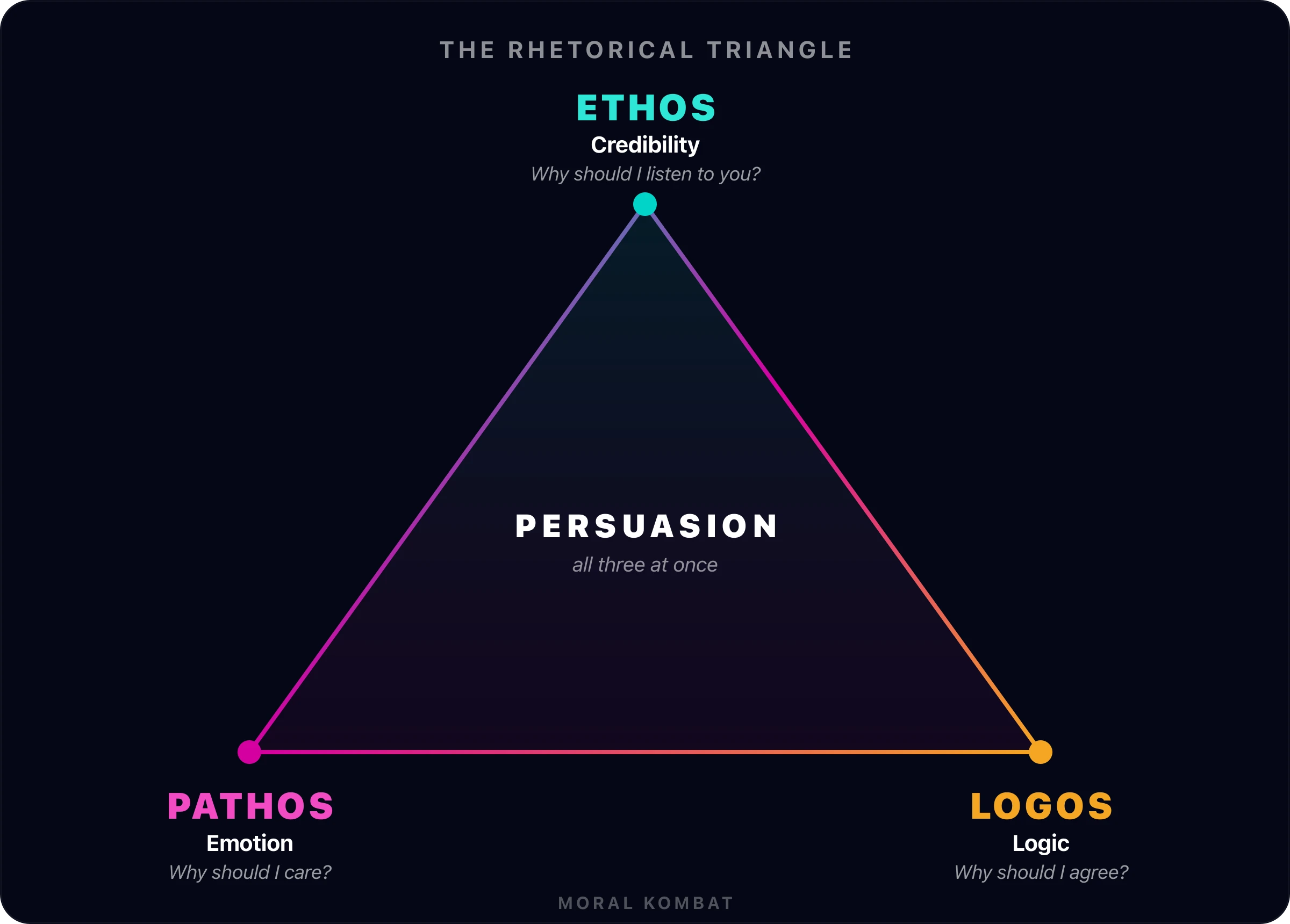
Picture a triangle. Each corner is one way to move a person, and a strong case touches all three.
- Ethos answers "why should I listen to you?" It is your credibility.
- Pathos answers "why should I care?" It is the emotional stake.
- Logos answers "why should I agree?" It is the logic and the evidence.
Miss a corner and the whole thing wobbles. All logic and no emotion, and you are correct but ignorable. All emotion and no logic, and you are stirring but hollow. All credibility and nothing behind it, and you are a suit with no substance. The skill is not picking one. It is balancing all three for the room in front of you.
Before anyone weighs your argument, they weigh you. Ethos is the trust you bring into the room before you have proven a single thing.
Some of it you arrive with: your track record, your expertise, your reputation. Most of it you build live, in how you carry the argument. You earn ethos when you:
- Show your work. Cite where your claims come from instead of just asserting them.
- Concede fairly. Admitting a good point from the other side signals you are after the truth, not just the win. It feels counterintuitive, and it is one of the fastest ways to gain credibility.
- Stay composed. A calm voice under pressure reads as someone who trusts their own case.
- Get the small things right. One sloppy fact and the audience quietly discounts everything else you say.
Ethos is slow to build and fast to lose. One exaggeration, one cheap shot, one number that does not check out, and the trust you spent the whole debate earning is gone.
Weak: "Trust me, I know what I am talking about." Strong: "I have spent ten years on this, and here is the part that surprised me." The first demands trust. The second earns it, and lets the audience feel let in rather than lectured.
Logic tells people what is true. Emotion tells them why it matters. Pathos is not manipulation, it is the difference between a statistic and a reason to lean forward.
"Forty thousand people are affected" is logos. It informs. "One of them is someone's mother, and this is the call she got" is pathos. It lands. The number gives the argument scale. The story gives it a pulse.
The tools of pathos are concrete and learnable:
- Tell one story, not ten stats. A single vivid example outpulls a spreadsheet every time.
- Use the audience's values, not yours. Frame the stakes in terms of what they already care about.
- Choose words with a temperature. "Lost their home" hits harder than "experienced housing insecurity," and both can be true.
The danger is overreach. Pathos with no logos behind it curdles into melodrama, and audiences feel the manipulation the moment they suspect the feeling is doing all the work. Emotion earns attention. It cannot close the argument on its own.
Logos is the backbone: the evidence, the structure, the reasoning that would still stand if you stripped every ounce of charm out of it.
This is the corner debaters trust most, and rightly, because it is the one that survives scrutiny. Facts, data, clear cause and effect, a conclusion that actually follows from its premises. Logos is also where arguments quietly fall apart, because a chain of reasoning is only as strong as its weakest link, and a single logical fallacy can collapse the whole thing.
Strong logos means:
- Evidence that fits the claim. Not more data, the right data.
- Reasoning the audience can follow. If they cannot trace how you got from A to B, they will not come with you.
- Structure they can hold. Three clear points beat nine blurry ones.
But logos alone rarely wins. Give a room airtight logic with no credibility and no stake, and they will agree with you on paper and forget you by the exit.
Almost everyone has a home corner.
The expert leans on ethos and forgets to make anyone care. The activist leans on pathos and skips the evidence. The engineer leans on logos and cannot understand why the room, convinced on the merits, still went the other way. Each is running one track and losing to people running three.
The most persuasive person in the room is rarely the smartest or the most passionate. It is the one who remembered to be all three: trustworthy, moving, and right.
The fix is to audit your own case before you deliver it. You have the logic, so where is the human stake? You have the passion, so where is the proof? You have the reputation, so what are you actually claiming?
Take a single argument and watch the layers stack.
Logos alone: "Remote work cut our costs by eighteen percent and raised output."
Add ethos: "I ran this team through the switch myself, so I watched the numbers up close: costs down eighteen percent, output up."
Add pathos: "I ran this team through the switch myself. Costs fell eighteen percent, output rose, and for the first time our best engineer stopped talking about quitting to see her kids. That is what the number actually bought."
Same fact, three times the force. Nothing was exaggerated and the evidence never changed. It was just given a source to trust and a reason to matter.
That is the whole craft. Not choosing between the head and the heart, but reaching both without lying to either.
You cannot learn this from a diagram. You learn it by watching which arguments actually move people, and then reverse-engineering why.
Pick any live debate and, instead of tracking who you agree with, track the room. When it shifts, ask which lever just got pulled. Someone established credibility. Someone made it matter. Someone finally connected the dots. Then look at how a Moral Kombat debate works: the audience decides the winner, which means the debater who touches all three corners, trustworthy and moving and right, is the one who walks away with the votes.
Being right gets you into the argument. Ethos, pathos, and logos are how you win it.