A bad argument that sounds right is more dangerous than one that sounds wrong.
The wrong-sounding kind gets ignored. The right-sounding kind wins rooms, sways votes, and ends friendships, all while being built on nothing. That gap between how an argument feels and whether it holds is where logical fallacies live.
A logical fallacy is a move in reasoning that looks valid and is not. Some people deploy them on purpose. Most of us reach for them by accident, under pressure, when we want to win more than we want to be right. Learning to spot them is the closest thing debate has to a superpower, because once you can name the trick, it stops working on you.
Here is the field guide: the fallacies you will actually run into, how to catch them in real time, and how to respond without turning into the person who yells "strawman" at everything.
Fallacies survive because they are shortcuts, and human brains love shortcuts.
Attacking a person is easier than engaging their argument. Reacting to fear is faster than weighing evidence. Agreeing with a confident authority saves you the trouble of checking. Every common fallacy is a real mental reflex doing exactly what it evolved to do, just pointed in the wrong direction.
That is why naming them matters. A fallacy you can name is a reflex you can interrupt. A fallacy you cannot name just feels like losing.
You do not need the academic list of two hundred. In practice, a handful show up again and again. Learn these cold.
| Fallacy | The move | The tell |
|---|
| Ad hominem | Attack the person, not the point | The subject switches from the claim to the claimant |
| Straw man | Beat a weaker version of their case | "So what you're really saying is..." followed by something they never said |
| Slippery slope | Treat step one as if it guarantees step ten | A chain of "and then" with no evidence for any link |
| False dilemma | Offer two options when more exist | "Either we do this, or disaster" |
| Whataboutism | Deflect a criticism with a counter-accusation | "What about when your side did..." |
| Appeal to authority | Cite status instead of evidence | The proof is who said it, not what they showed |
| Appeal to emotion | Substitute a feeling for a reason | It makes you feel something but proves nothing |
| Hasty generalization | Draw a big rule from a tiny sample | "I met one, and they were all..." |
| Circular reasoning | Assume the thing you are proving | The conclusion is hidden inside the premise |
| Correlation as causation | Two things move together, so one caused the other | A real pattern, an invented arrow between them |
Now the ones you will meet most, up close.
Ad hominem
The oldest trick there is: when you cannot beat the argument, go after the arguer. "You would say that, you work in finance." Maybe they would. It still has nothing to do with whether they are right.
Ad hominem works because it feels like a point. It is not. A claim is true or false regardless of who makes it, their job, their past, or how much you dislike them.
Straw man
You do not answer your opponent. You build a flimsy dummy that looks like them, then knock it over. "You want lighter restrictions? So you want total chaos." Nobody said total chaos. The dummy did.
The antidote is the opposite move, and it is the single most trust-winning thing you can do in a debate: steelman their case instead, restate it in its strongest form, then respond to that. Beating the real argument convinces people. Beating a dummy convinces no one who was paying attention.
Slippery slope
If we allow A, then B, then C, and before you know it, Z. Each link is presented as inevitable, and none of them is proven. Sometimes slopes are real. Usually the person shouting about the bottom of the hill has not shown you a single step down it.
Ask for the mechanism. "Walk me through how the first thing forces the second." If they cannot, the slope was imaginary.
False dilemma
"You are either with us or against us." Two doors, when the room has ten. The false dilemma wins by hiding the options that would let you disagree without joining the other team. The counter is simple: name a third door. The moment you show one more real option, the whole frame collapses.
Whataboutism
A criticism lands, and instead of answering it they fire back with a crime from your side. "You are worried about our spending? What about the last administration?" Maybe the other side was worse. That does not make the current point false. Whataboutism trades a question you can answer for an argument you both enjoy more, and the original issue quietly slides off the table.
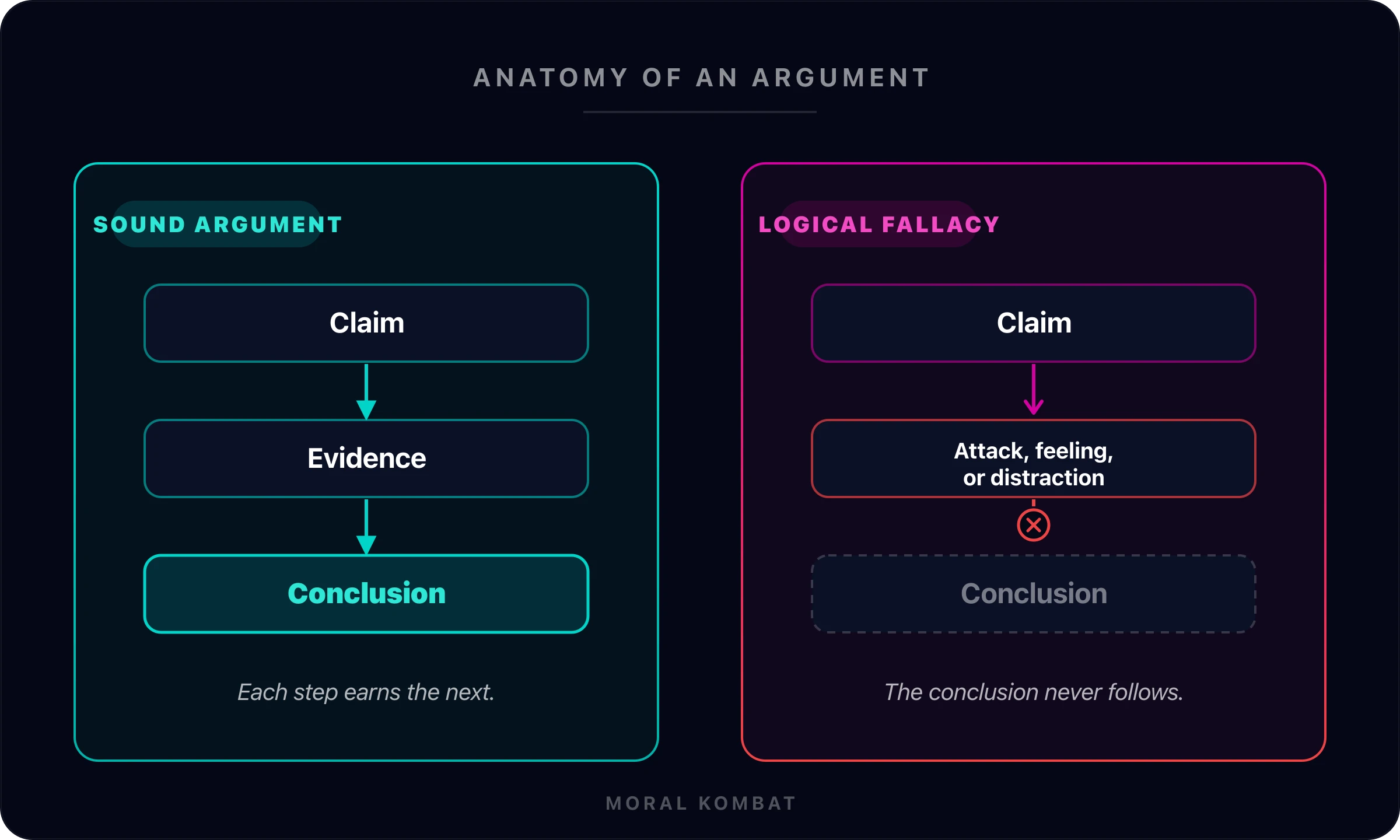
Spotting a fallacy is half the skill. The other half is calling it out in a way that persuades the room instead of annoying it. Three rules.
Name the move, not the label. Do not say "that is a textbook ad hominem." Most of the audience never took a logic class and will feel talked down to. Say what happened in plain words: "That is about me, not about the point. Let us go back to the point." Same catch, no jargon, no smugness.
Redirect, do not gloat. The goal is to get back to the real argument, not to score a debate-club point. Catch the trick, then immediately return to substance. The audience remembers who kept things on track, not who knew the fancy name.
Do not cry fallacy at everything. This is the trap. Not every emotional appeal is a fallacy, sometimes a feeling is exactly the right evidence. Not every mention of an expert is an appeal to authority, experts often are the evidence. A fallacy is a substitute for reasoning, not the mere presence of emotion or authority. Calling "fallacy" on legitimate arguments is itself a way of dodging them, and rooms notice.
Here is the whole sequence in one exchange:
Them: "Of course you would defend this, you have never run a business."
You: "That is about me, not the policy. Let us stay on the policy. You said it raises costs, so show me where."
No label, no lecture, no gloat. You named the move in plain language and put the burden right back where it belongs. The room saw all of it.
The point of spotting a fallacy is never to win the label. It is to get the conversation back to the thing that is actually true or false.
Confirmation bias rarely makes the classic lists, because it is less a debate trick than a private one. It is the reflex to wave through any argument that agrees with you, fallacies and all, while demanding airtight proof from any argument that does not.
Which means the fallacy hardest to catch is always your own. The test worth running before every debate: take your strongest argument and hunt it for the tells in that table above. If you find one, better you than your opponent.
Fallacies are easy to nod along with on a page and hard to catch live, at speed, when someone confident is looking you in the eye. The only way to get fast is reps.
Watch any live debate with that table open and just tag the moves as they happen. You will start seeing them everywhere, in adverts, in politics, in your own group chat. Then look at how a Moral Kombat debate works: the audience votes on who made the better case, which means a well-timed catch of a shaky argument does not just feel good, it moves the score.
The best debaters are not the ones who never face a fallacy. They are the ones who see it coming, name it in a sentence, and get straight back to being right.